Protecting Enterprise Value Before FDA Arrives
The Executive Case for a Mock FDA Inspection
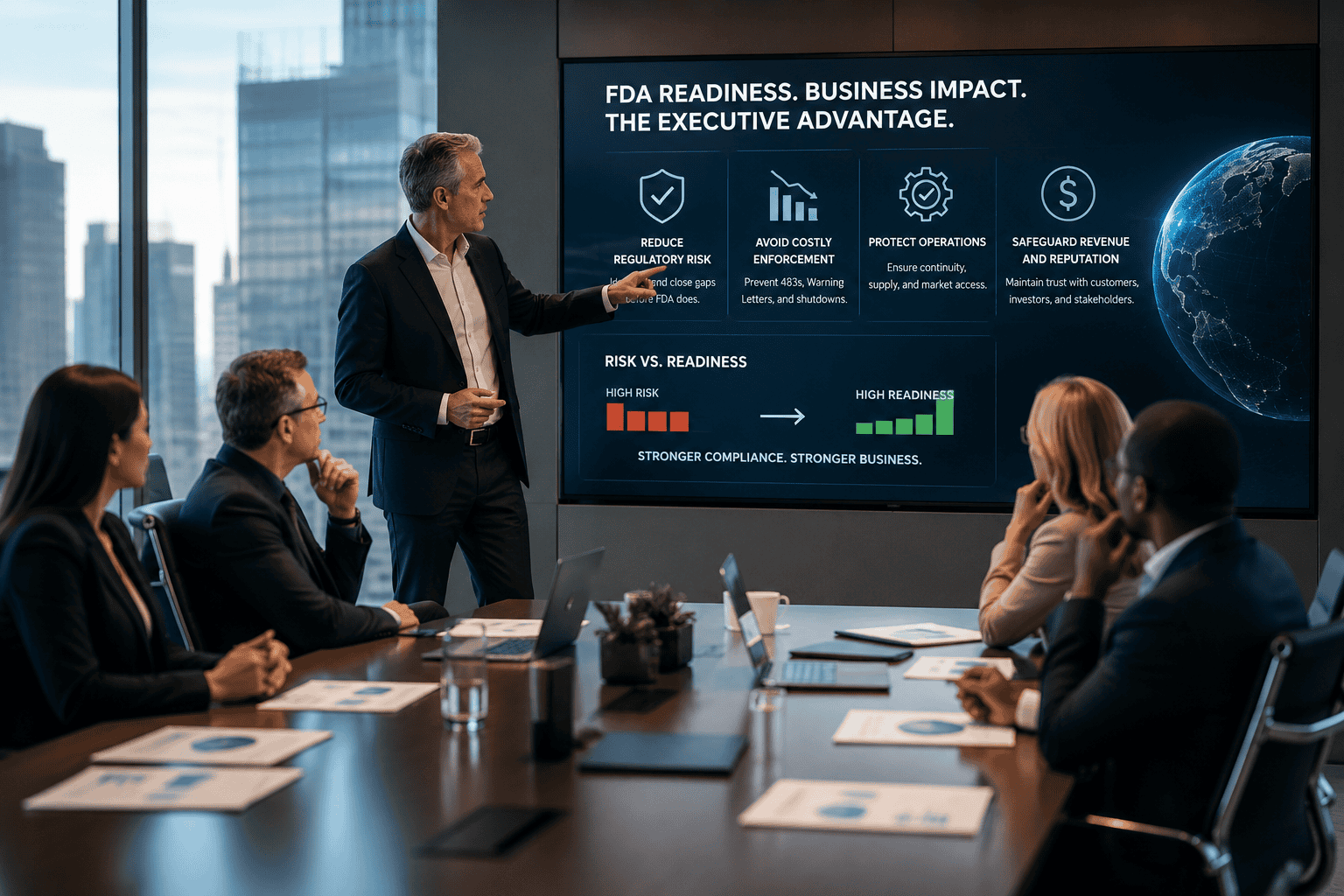
The Executive Case for a Mock FDA Inspection is straightforward: it is one of the practical investments leadership can make to protect enterprise value. It reveals compliance weaknesses before FDA investigators identify them, allowing executives to correct deficiencies while the organization controls the timeline, cost, and response strategy. A well-designed mock FDA inspection tests quality systems, data integrity, CAPA effectiveness, management oversight, process controls, and employee readiness under realistic inspection conditions. Its value extends beyond avoiding a Form 483 or Warning Letter. It also helps protect production continuity, market access, customer confidence, investor trust, and corporate reputation. For pharmaceutical, medical device, and combination product manufacturers, regulatory problems can quickly become business problems. A mock FDA inspection gives executives an independent view of those risks and a prioritized roadmap for action. The earlier the leadership invests in inspection readiness, the greater the opportunity to prevent costly disruption and strengthen operational resilience.
Independent Executive Assurance
Test the Strength of Your Quality Unit
A second major return on investment is the opportunity to independently test your quality systems and quality unit. Executives should not rely solely on internal reports, routine metrics, or assurances that everything is under control. A mock FDA inspection provides an essential check and balance by evaluating whether the quality function has sufficient authority, resources, technical competence, and independence to identify and escalate compliance risks.
The assessment also reveals whether management receives accurate information or only a polished version of operational performance. Former FDA investigators challenge investigations, CAPA, management review, data integrity, and decision-making under realistic inspection conditions. The objective is not to undermine the quality unit, but to determine how it performs when subjected to external regulatory scrutiny. For executives, this independent evaluation provides clearer visibility into weaknesses that could otherwise remain hidden until the FDA arrives.
See Your Quality Systems Through the Eyes of a Former FDA Investigator
A mock FDA inspection allows executives to view their operations through the eyes of a former FDA investigator. Internal teams often become accustomed to existing procedures, explanations, and recurring issues. An experienced former investigator approaches the same systems differently—testing whether records are complete, explanations are credible, and corrective actions are supported by objective evidence.
This perspective helps identify connections that routine audits may miss, such as repeated deviations, weak investigations, unsupported root causes, ineffective CAPA, or inconsistencies between procedures and actual practices. It also reveals which issues are likely to trigger additional questions, broader sampling, or deeper regulatory scrutiny. For executives, this outside perspective provides a more realistic understanding of how the FDA may evaluate the organization before an actual inspection begins.
A Different Perspective Reveals a Different Story
Internal teams often evaluate quality systems through the same assumptions, procedures, and historical explanations they have relied on for years. A former FDA investigator brings a different perspective and examines the organization from an independent regulatory angle. That change in viewpoint can reveal a very different story.
Records that appear acceptable internally may show inconsistencies, unsupported conclusions, repeated deficiencies, or weak management oversight when reviewed through an investigator’s lens. A mock FDA inspection challenges familiar explanations and tests whether the evidence actually supports them. For executives, this independent perspective provides an essential check and balance, helping uncover risks that internal reviews may normalize, overlook, or unintentionally minimize before those risks become FDA inspection findings.
From Regulatory Risk to Business Risk
Protect Enterprise Value and Business Continuity
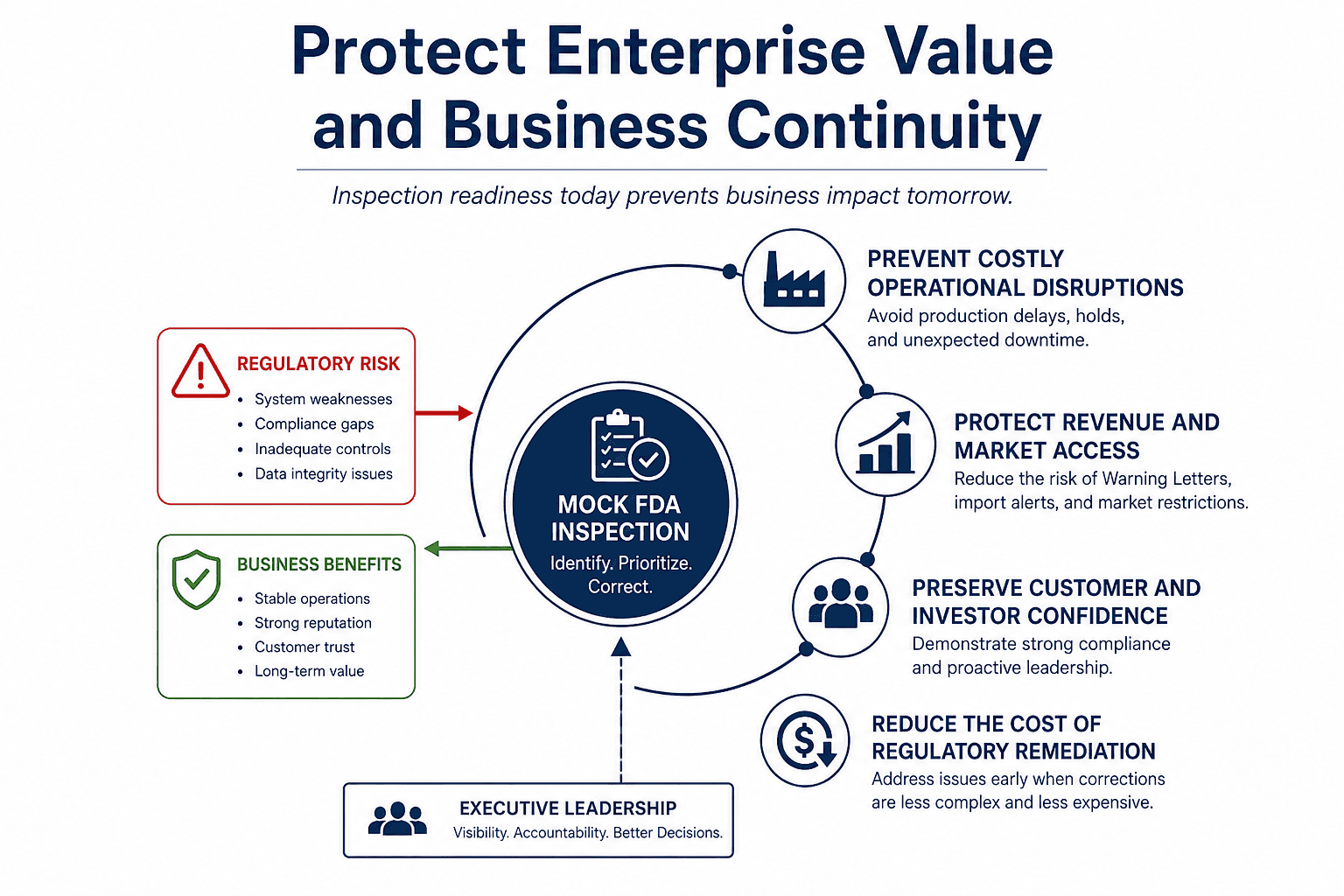
The Executive Case for a Mock FDA Inspection begins with protecting enterprise value and business continuity. Inspection findings can interrupt manufacturing, delay product release, restrict market access, damage customer relationships, and force leadership into expensive remediation. By identifying weaknesses before FDA arrives, executives gain time to correct deficiencies under controlled conditions instead of during an enforcement crisis. A mock FDA inspection evaluates whether quality systems, management oversight, data integrity, CAPA, and operational controls can withstand regulatory scrutiny. It also provides leadership with an independent view of risks that may not appear in routine reports or internal audits. The return is practical: fewer surprises, stronger resilience, better resource allocation, and greater protection of the company’s ability to manufacture, distribute, and compete. For executives, inspection readiness is a disciplined strategy for protecting revenue, reputation, operational continuity, and long-term corporate value.
Prevent Costly Operational Disruptions
The Executive Case for a Mock FDA Inspection includes preventing avoidable operational disruption. Production may slow while teams retrieve records, investigate deficiencies, respond to requests, and implement urgent corrections. Significant findings may affect product release, manufacturing schedules, supplier activity, or distribution. A mock FDA inspection helps executives identify these vulnerabilities while corrective work can still be planned and controlled. It tests whether critical processes, documentation, personnel, and decision-making remain reliable under regulatory pressure. Preventing even one interruption may justify the investment by preserving output, avoiding rushed remediation, and keeping the organization focused on customers instead of crisis management.
Protect Revenue and Market Access
The Executive Case for a Mock FDA Inspection includes protecting revenue and market access from preventable regulatory disruption. Warning Letters, import alerts, delayed approvals, and follow-up inspections may restrict commercial activity while deficiencies are corrected. A mock FDA inspection uncovers system weaknesses before they affect product release, importation, distribution, or customer commitments. Executives receive a prioritized view of compliance gaps and the time needed to correct them under controlled conditions. This preparation supports reliable production, stronger customer confidence, and fewer regulatory barriers. Protecting market access means protecting the company’s ability to generate revenue, fulfill contracts, maintain supply, and sustain long-term growth.
Preserve Customer and Investor Confidence
The Executive Case for a Mock FDA Inspection also involves preserving customer and investor confidence. Customers, investors, lenders, and business partners expect regulated manufacturers to maintain reliable operations and effective quality systems. Public enforcement actions can create doubt about leadership, product reliability, and the organization’s ability to control risk. A mock FDA inspection provides evidence that potential weaknesses are being independently tested and corrected before they become public problems. It also demonstrates that leadership treats inspection readiness as an enterprise responsibility rather than a narrow quality function. Trust is difficult and expensive to rebuild after enforcement, making proactive preparation a valuable executive investment.
Reduce the Cost of Regulatory Remediation
The Executive Case for a Mock FDA Inspection includes reducing the cost and disruption of regulatory remediation. Remediation rarely involves correcting one isolated document or procedure. Companies may need extensive investigations, retrospective reviews, process revalidation, additional staffing, outside specialists, new technology, and prolonged management oversight. A mock FDA inspection identifies weaknesses earlier, when corrective action is usually more manageable and less disruptive. It helps leadership prioritize risk, allocate resources intelligently, and avoid spending money on fixes that fail to address root causes. The cost of proactive preparation can be planned and controlled; the cost of enforcement-driven remediation is often unpredictable, prolonged, and significantly higher.
Executive Oversight and Accountability
Make FDA Inspection Readiness an Executive Responsibility
Make FDA Inspection Readiness an Executive Responsibility
The Executive Case for a Mock FDA Inspection begins with recognizing that FDA inspection readiness is an executive responsibility. Regulatory risk can quickly become operational, financial, and reputational risk, so leadership cannot assume the quality unit alone will identify and resolve every weakness. Executives must set expectations, provide resources, and require transparent reporting of unresolved issues. A mock FDA inspection gives leadership an independent view of whether systems, personnel, and management controls can withstand regulatory scrutiny. It also reveals whether compliance risks are escalated accurately or softened as information moves upward. Executive involvement does not mean managing every technical detail. It means ensuring the organization has the authority, discipline, visibility, and accountability needed to correct deficiencies before FDA identifies them. When leadership owns inspection readiness, corrective actions receive stronger support, decisions improve, and business priorities remain aligned with regulatory obligations.
Quality Compliance Is a Leadership Obligation
The Executive Case for a Mock FDA Inspection includes a reality: quality compliance is a leadership obligation. Senior management is responsible for ensuring the organization operates within FDA requirements and that risks are addressed before they threaten the business. Executives establish priorities, approve resources, and determine whether quality concerns receive immediate attention or remain unresolved. A mock FDA inspection shows whether compliance commitments are supported by decisions and behavior. When leadership treats quality as an enterprise responsibility, departments cooperate more effectively, recurring issues receive stronger oversight, and the organization is better prepared to demonstrate management accountability during an FDA inspection.
Give the Quality Unit Authority and Resources
The Executive Case for a Mock FDA Inspection also depends on whether the quality unit has real authority and adequate resources. Executives should ensure quality personnel can stop operations, reject products, escalate concerns, and require corrective action without commercial pressure. A mock FDA inspection tests whether that authority exists in practice or only in written procedures. It may reveal delayed decisions, inadequate staffing, weak independence, or situations where production priorities override quality concerns. Giving the quality unit proper authority, access, and resources strengthens compliance, improves decision-making, and reduces the likelihood that known weaknesses remain unresolved until FDA investigators identify them.
Require Visibility Into Unresolved Compliance Risks
The Executive Case for a Mock FDA Inspection requires direct visibility into unresolved compliance risks. Executives need information about deviations, ineffective CAPA, data integrity concerns, repeat observations, and overdue corrective actions. Routine dashboards may hide these issues when information is summarized before reaching leadership. A mock FDA inspection provides an independent assessment of which risks are recurring or likely to attract regulatory attention. Leadership should require transparent reporting that identifies ownership, deadlines, root cause status, and barriers to completion. Better visibility allows executives to prioritize resources, challenge weak explanations, and intervene before problems become Form 483 observations or Warning Letters.
Hold Management Accountable for Sustainable Corrections
The Executive Case for a Mock FDA Inspection is incomplete without accountability for sustainable correction. Corrective actions should not be considered complete because procedures were revised or training was performed. Management must verify that root causes were addressed, actions were implemented, and recurrence is unlikely. A mock FDA inspection tests whether corrections are effective, measurable, and sustained across departments and sites. Executives should require clear acceptance criteria, responsible owners, completion dates, and effectiveness checks. Holding management accountable for permanent correction reduces repeat violations, prevents temporary fixes from creating false confidence, and avoids spending on problems that should have been resolved.
An Executive Decision Before FDA Arrives
Invest in Inspection Readiness Before Enforcement
The Executive Case for a Mock FDA Inspection ultimately comes down to timing. Before FDA arrives, leadership controls the schedule, budget, scope, and pace of corrective action. After significant findings, those choices narrow, and remediation may be driven by regulatory deadlines, operational disruption, and enforcement risk. A mock FDA inspection gives executives an independent assessment of quality systems, management oversight, data integrity, CAPA, and operational readiness before weaknesses become inspectional observations. It also creates a prioritized plan for correcting the issues most likely to threaten business continuity, market access, and reputation. The investment is measured not only by findings prevented but also by disruptions avoided, resources allocated intelligently, and stakeholder confidence preserved. Inspection readiness is less expensive, more controlled, and more strategic when leadership acts before FDA sets the timetable.
Executive Questions About Mock FDA Inspections
What Is the ROI of a Mock FDA Inspection?
The ROI of a mock FDA inspection comes primarily from identifying and correcting compliance weaknesses before they result in operational disruption or regulatory enforcement. Its value may include avoided production delays, reduced remediation costs, protected market access, stronger customer confidence, and more efficient allocation of quality resources. While the exact financial return varies, preventing even one significant inspection finding or business interruption may justify the investment.
Can a Mock FDA Inspection Prevent a Warning Letter?
No consultant can guarantee that a mock FDA inspection will prevent a Warning Letter. However, a properly conducted assessment can significantly reduce risk by identifying compliance gaps, repeated deficiencies, ineffective CAPA, weak investigations, and management oversight failures before FDA does. The value depends on whether leadership acts on the findings and implements sustainable corrective actions before an actual inspection.
How Often Should Manufacturers Conduct a Mock FDA Inspection?
The appropriate frequency depends on the company’s products, compliance history, operational changes, and regulatory risk. A mock FDA inspection should be considered before an expected FDA inspection, after major facility or process changes, following significant remediation, or when recurring quality problems indicate that existing controls may not be effective. Higher-risk operations may benefit from periodic assessments rather than waiting for an inspection announcement.
Should a Mock FDA Inspection Be Onsite or Remote?
The format should match the purpose and scope of the assessment. An onsite mock FDA inspection is generally more effective for evaluating facilities, manufacturing operations, physical controls, and employee practices. A remote assessment can efficiently test documentation, electronic systems, interviews, and document retrieval. A hybrid approach may provide the strongest coverage by combining onsite operational review with remote follow-up and remediation support.
Who Should Conduct a Mock FDA Inspection?
A mock FDA inspection should be conducted by an independent professional with direct knowledge of the applicable FDA regulations, compliance program, product type, and inspection methodology. Former FDA investigators can provide valuable insight into how records, explanations, and quality systems may be evaluated during an actual inspection. Relevant experience and the ability to challenge systems objectively matter more than using a generic audit checklist.
Reviewed by a Former FDA Investigator
Reviewed by a former FDA Investigator, Compliance Officer, and Supervisory Investigator with experience conducting drug and medical device inspections, reviewing Form 483 observations, and drafting FDA enforcement correspondence.