FDA PRE-APPROVAL INSPECTION READINESS
Mock FDA Pre-Approval Inspection (PAI)
A Mock FDA Pre-Approval Inspection (PAI) helps manufacturers assess readiness before Agency review of facilities named in a pending application. Our FDA Consulting approach adapts the assessment to drugs, medical devices, and combination products. For drug applications, the review examines commercial manufacturing readiness, application conformance, laboratory operations, and data integrity. Medical device assessments evaluate PMA manufacturing readiness and compliance with the current Quality Management System Regulation. Combination product reviews address the applicable CGMP framework, constituent-part requirements, and 21 CFR Part 4. Each FDA mock inspection follows the product, application, facility role, and relevant inspection program. Experienced advisors review procedures, records, validation evidence, quality oversight, and operational controls. The resulting assessment identifies potential gaps and supports practical remediation before Agency review. Although the Agency uses a risk-based process and may not inspect every facility, early preparation helps teams present reliable evidence.
PRE-APPROVAL INSPECTION OVERVIEW
What Is a Mock FDA Pre-Approval Inspection?
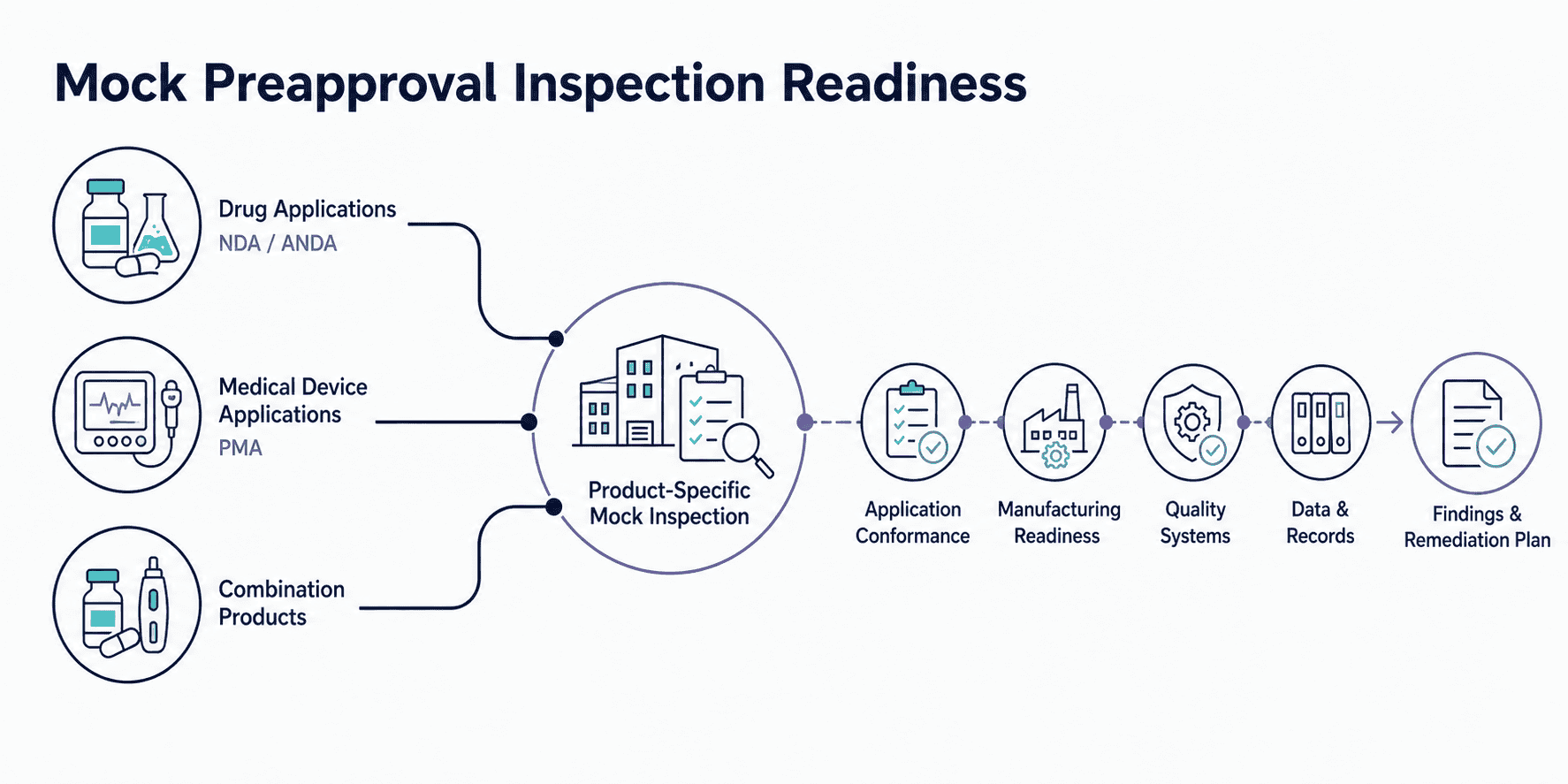
A Mock FDA Pre-Approval Inspection is an independent, product-specific assessment that helps manufacturers prepare for an Agency inspection. The review does not replace Agency oversight, predict approval, or apply one checklist for every product. Instead, advisors tailor the scope to the application, facility and operations, and applicable requirements. Drug assessments may examine commercial readiness, application conformance, controls, process validation, and data integrity. Medical device reviews evaluate PMA manufacturing readiness and compliance with the current QMSR. Combination product reviews consider parts, application type, lead center, and 21 CFR Part 4 requirements. During the assessment, advisors review records, interview personnel, observe operations, and test inspection-response procedures. Our FDA Consulting approach identifies potential gaps and prioritizes practical remediation activities. Preparation cannot guarantee approval or prevent observations. However, it can strengthen documentation, staff readiness, operational control, and consistency before the Agency evaluates the facility.
PRE-APPROVAL INSPECTION TIMING
When May the FDA Conduct a Pre-Approval Inspection?
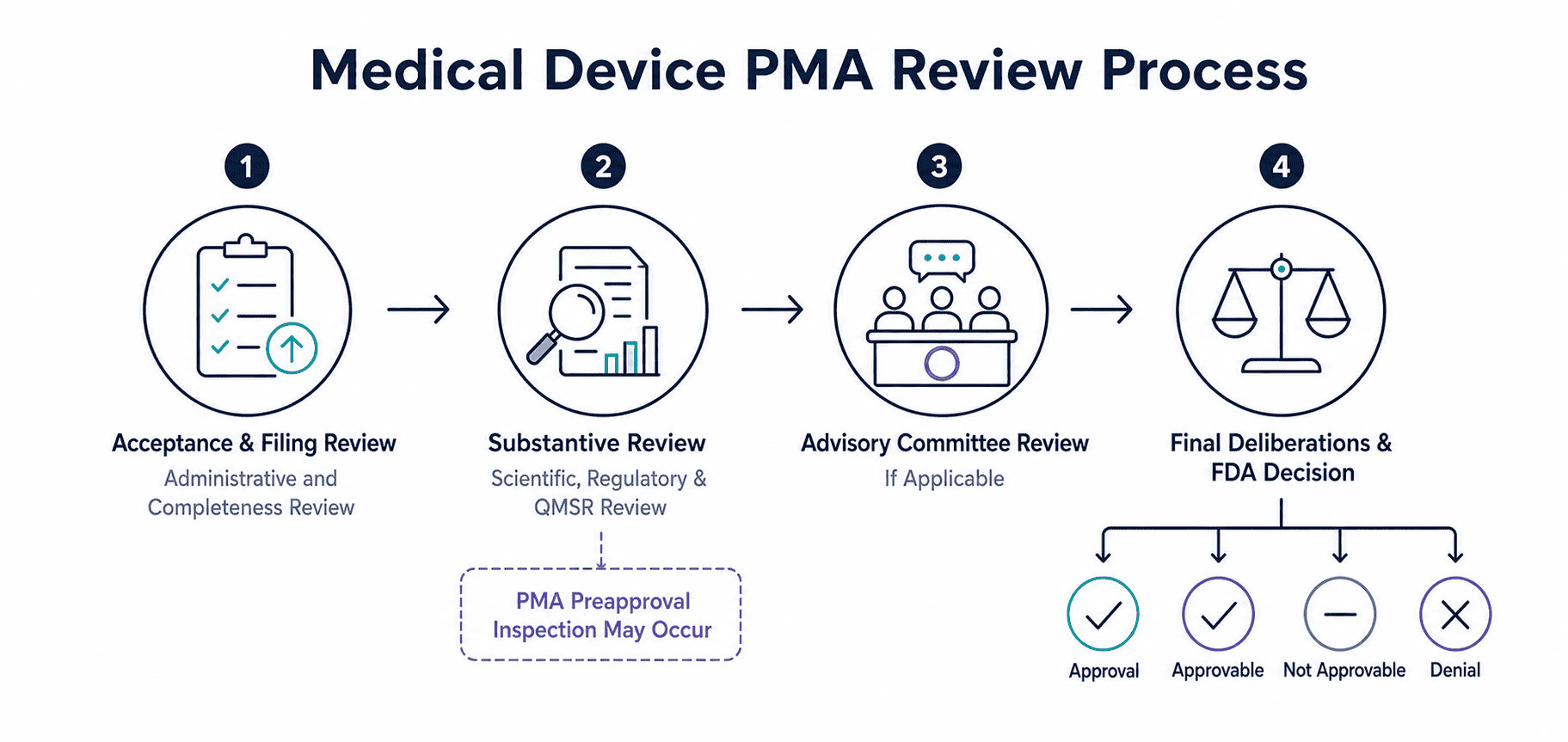
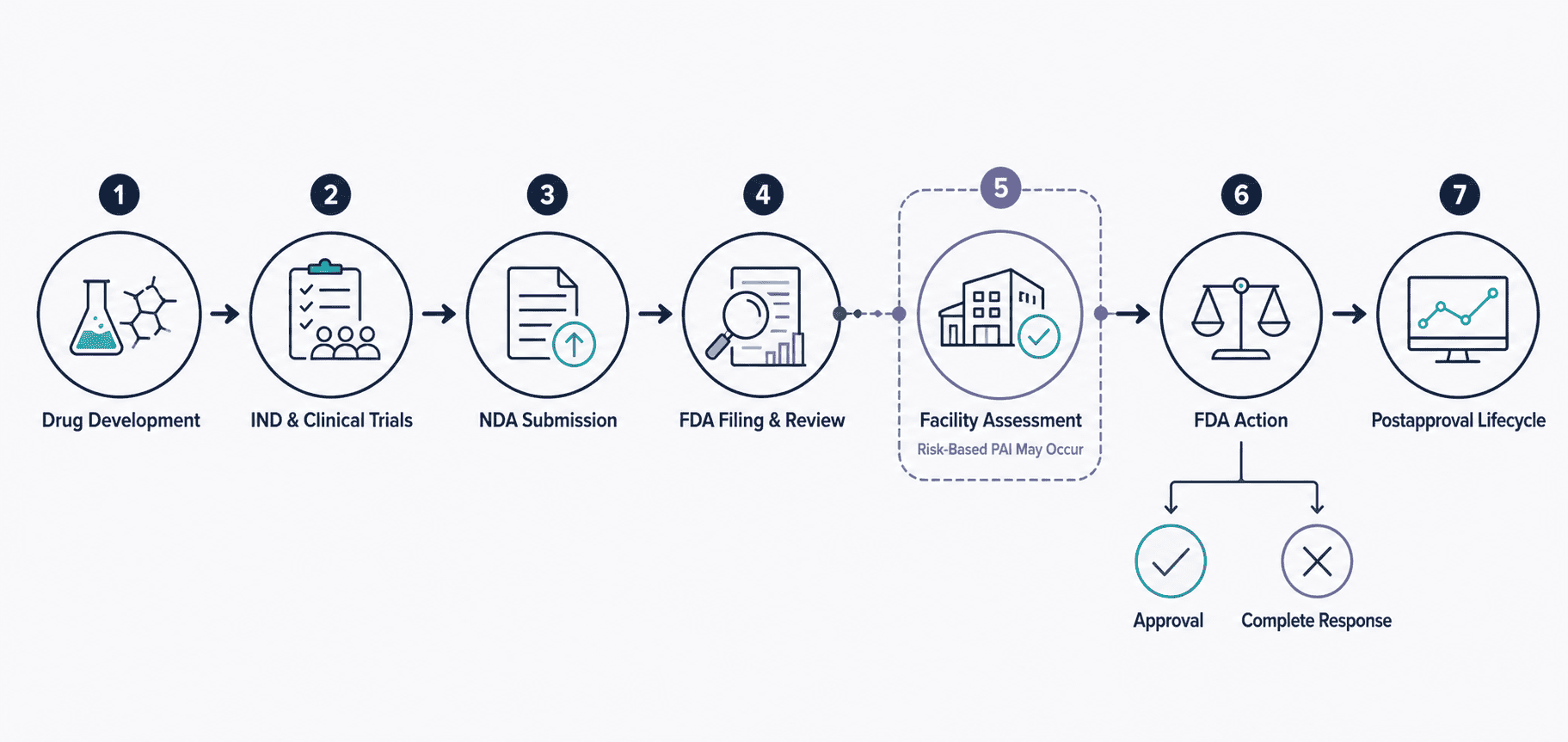
FDA uses a risk-based process to decide whether a pre-approval inspection is necessary for an application. The Agency may consider risk, process complexity, facility history, manufacturing role, information, and inspection coverage. A drug facility may receive a PAI when reviewers need evidence of commercial readiness, application conformance, or manufacturing data. For medical devices, the Agency may inspect facilities named in an original PMA or certain manufacturing-related supplements. Combination product decisions reflect the lead center, application type, constituent parts, and CGMP operating system. Not every application or facility receives an onsite inspection. The Agency may use records requests, remote assessments, prior inspection information, or trusted regulatory partners when appropriate. An FDA mock inspection helps teams prepare for possible scrutiny without assuming an inspection will occur. Our FDA Consulting support aligns preparation with the relevant application, facility responsibilities, and current Agency expectations.
Product-Specific Pre-Approval Inspections
Pre-approval inspections share readiness goals, but the Agency applies frameworks according to product and application type. Drug PAIs may evaluate manufacturing readiness, CMC conformance, laboratory controls, process validation, data integrity, and pharmaceutical quality systems. Medical device PMA inspections assess whether facilities can manufacture the approved design consistently under the current QMSR. These reviews may examine design transfer, process controls, validation, oversight, records, and management responsibility. Combination product inspections follow the lead application and applicable constituent-part requirements. The Agency may apply drug CGMPs, the device QMSR, applicable biological requirements, and 21 CFR Part 4. A Mock FDA Pre-Approval Inspection must therefore use a product-specific scope rather than a universal checklist. Our FDA Consulting approach identifies the controlling application, facility responsibilities, and relevant compliance framework. This distinction helps teams prepare appropriate evidence while avoiding gaps created by applying the wrong inspection model.
What the Mock Inspection Evaluates
Our Mock FDA Pre-Approval Inspection evaluates whether a facility can support the manufacturing commitments described in its application. Advisors examine product-specific operations, quality oversight, documentation, validation evidence, and staff readiness. For drugs, coverage may include commercial-scale manufacturing, CMC conformance, laboratory controls, data reliability, investigations, and systems. Device assessments may review design transfer, process controls, supplier management, validation, records, and compliance with the QMSR. Combination product coverage considers the applicable CGMP operating system and requirements for each constituent part. The assessment also tests how personnel retrieve documents, explain decisions, and respond to challenging inspection questions. Our FDA Consulting team traces information across procedures, records, electronic systems, and application content. Findings receive context based on regulatory significance and operational risk. The assessment does not predict approval. Instead, it gives management a focused view of readiness and areas requiring correction before Agency review.
Application Conformance and Manufacturing Readiness
Application conformance means that facility operations, records, methods, and controls reflect the information submitted for Agency review. For drug applications, advisors compare manufacturing instructions, analytical methods, batch records, specifications, and commercial processes against CMC commitments. Medical device assessments compare design outputs, specifications, validation evidence, labeling controls, and production methods with the PMA. Combination product reviews examine alignment across the lead application, constituent parts, and CGMP operating system. Commercial readiness also requires trained personnel, qualified equipment, materials, reliable laboratories, and quality oversight. An FDA mock inspection can test whether teams explain differences, changes, deviations, and development issues consistently. Our FDA Consulting approach traces commitments from the application into procedures and records. Any discrepancy requires evaluation because unsupported differences may delay review or raise compliance concerns. Strong preparation helps the facility demonstrate that operations can produce the application product at commercial scale.
Quality Systems and CGMP Readiness
Quality system readiness depends on the product, application pathway, activities, and regulations governing each facility. Drug manufacturers follow applicable CGMP requirements in 21 CFR Parts 210 and 211. Medical device manufacturers must comply with the QMSR, which incorporates ISO 13485:2016 into 21 CFR Part 820. Combination product manufacturers follow 21 CFR Part 4 and applicable requirements for drug, device, or biological constituent parts. A streamlined combination product approach requires coverage of specified provisions from the non-base framework. During a Mock FDA Pre-Approval Inspection, advisors evaluate management oversight, procedures, records, investigations, corrective actions, change control, and implementation. Our FDA Consulting review focuses on how the written system performs in practice. The Agency may question procedures that appear adequate but lack consistent execution or reliable evidence. Effective readiness therefore requires both compliant documentation and demonstrated control across daily manufacturing and quality activities.
Process Validation and Laboratory Readiness
Process validation helps demonstrate that operations can consistently produce output meeting predetermined requirements and product specifications. Drug readiness may include process performance qualification, continued process verification, cleaning validation, analytical methods, laboratory systems, and operations. Device readiness may cover validation, sterilization, software used in manufacturing, environmental controls, test methods, and design transfer. Combination product assessments may require coordinated evidence for both drug and device constituent parts. An FDA mock inspection examines whether protocols, acceptance criteria, deviations, conclusions, and approvals support validation decisions. Advisors trace equipment qualification, calibration, maintenance, materials, sampling, testing, and release controls. Our FDA Consulting approach challenges gaps between written procedures and practice. The Agency may scrutinize incomplete studies, unsupported changes, failures, or commercial processes that differ from application commitments. Strong readiness requires justified controls, trained personnel, reliable laboratories, and records showing continued process performance before commercial distribution begins.
Data Integrity, Documentation, and Traceability
Reliable data allow the Agency to evaluate whether application information and evidence are accurate, complete, and trustworthy. Drug PAIs may include audits of raw data supporting CMC submissions, analytical results, batches, validation, and readiness. Device reviews may trace design, validation, complaint, supplier, and quality records supporting the PMA and QMSR compliance. Combination product assessments may follow records across constituent parts, facilities, and electronic systems. During an FDA mock inspection, advisors test retrieval, audit trails, access controls, record reconciliation, and investigation practices. Our FDA Consulting review examines whether personnel understand contemporaneous documentation and data-governance responsibilities. Missing records, unexplained changes, unofficial worksheets, or inconsistent values can undermine confidence in the quality system. Traceability should connect submitted information with source data, procedures, executed records, and reported conclusions. Effective controls help teams present reliable evidence and explain the history of decisions during Agency review.
Suppliers and Multi-Site Operations
Preapproval readiness extends beyond one facility when suppliers, laboratories, contract manufacturers, sterilizers, or packagers support the application. The Agency may evaluate each site’s responsibilities, risk, inspection history, and relationship to commercial operations. Drug applications identify facilities that manufacture, test, package, label, or hold drug substances and finished products. PMA reviews may involve finished-device manufacturers, specification developers, contract manufacturers, suppliers, and sterilization facilities. Combination products can add responsibilities across drug, device, and biological constituent-part operations. A Mock FDA Pre-Approval Inspection should trace quality agreements, transfers, purchasing controls, changes, deviations, investigations, and data exchange. Our FDA Consulting clarifies ownership before challenging how sites coordinate decisions and escalate issues. Management should confirm that application information matches responsibilities at every named facility. Effective oversight requires more than signed agreements. It requires documented monitoring, communication, and evidence that management controls outsourced activities affecting product quality.
How the Mock Inspection Works
Each Mock FDA Pre-Approval Inspection begins with a review of the application, facility role, risks, and scope. Our FDA Consulting team then develops a product-specific plan based on Agency programs and regulatory requirements. Advisors may review procedures, application commitments, validation records, quality data, investigations, training, and documentation before fieldwork. During the assessment, they conduct interviews, request records, trace data, observe operations, and challenge explanations as investigators might. Remote, onsite, or hybrid delivery can support facilities and timelines. Daily discussions can identify concerns without interrupting the independent evaluation. After fieldwork, advisors organize findings by significance, evidence, responsible system, and priority. Management receives a closing discussion that explains observed gaps and regulatory implications. The assessment does not promise exact Agency coverage or outcomes. Instead, the process gives teams experience, clearer responsibilities, and a structured foundation for remediation before an inspection or assessment.
Common Readiness Gaps
Common readiness gaps involve differences between application commitments and facility procedures or records. Drug manufacturers may encounter incomplete process validation, weak investigations, laboratory-control deficiencies, data discrepancies, or scale-up changes. Device manufacturers may find gaps in design transfer, supplier oversight, validation, risk management, or QMSR implementation. Combination product facilities may misunderstand Part 4 or incompletely apply a streamlined CGMP approach. An FDA mock inspection can reveal slow retrieval, inconsistent interview responses, unclear ownership, and ineffective escalation practices. Our FDA Consulting review evaluates whether corrective actions address root causes and prevent recurrence. Concerns may include outdated specifications, unsupported methods, insufficient training, missing quality agreements, or weakly controlled electronic records. The Agency evaluates evidence within the application and facility context, so isolated documents rarely establish readiness. Early identification allows management to prioritize corrections, verify effectiveness, and resolve significant weaknesses before formal Agency review.
Mock Inspection Deliverables
After the Mock FDA Pre-Approval Inspection, management receives a structured summary of findings supported by evidence and facility context. The deliverable distinguishes significant readiness concerns from lower-priority improvement opportunities without predicting the Agency’s assessment. Each finding identifies the affected system, condition, supporting records, and potential regulatory relevance. When appropriate, advisors recommend practical actions, responsible functions, and sequencing for remediation. Our FDA Consulting team may also provide an executive briefing, report, document-request observations, and interview-readiness feedback. Drug, device, and combination product findings remain tied to the application and compliance framework. The assessment results can support corrective action planning, resource decisions, leadership oversight, and follow-up verification. Management retains responsibility for evaluating recommendations and implementing suitable corrections. An effectiveness review can test whether revised procedures and controls work consistently. Clear deliverables help teams convert inspection observations into accountable readiness activities before Agency review.
When to Schedule the Mock Inspection
Schedule a Mock FDA Pre-Approval Inspection after critical systems and commercial processes become mature for meaningful evaluation. Conducting it too early may identify development work rather than true readiness gaps. Waiting until the Agency announces an inspection can leave insufficient time for remediation, training, and effectiveness checks. Drug manufacturers should consider application timing, process validation, method readiness, exhibit or commercial batches, and availability. PMA manufacturers should align the assessment with design transfer, production readiness, validation completion, and QMSR implementation. Combination product teams should confirm the lead application, constituent responsibilities, and CGMP approach before testing readiness. Our FDA Consulting team can help determine a scope and sequence based on maturity. Additional assessments may support new facilities, transfers, changes, or unresolved compliance concerns. The best timing provides enough evidence for evaluation and enough remaining time to correct meaningful gaps before Agency review.
Prepare for Your Pre-Approval Inspection
Preapproval readiness requires evidence, capable personnel, controlled operations, and clear alignment between the application and facility practices. Begin by confirming each site’s responsibilities, applicable requirements, submission commitments, and quality-system status. Management should resolve discrepancies, complete validation, strengthen investigations, and verify that corrective actions work. Teams need practice retrieving records, explaining decisions, and responding accurately without speculation. A Mock FDA Pre-Approval Inspection provides an opportunity to test these capabilities under realistic conditions. Our FDA Consulting approach adapts the assessment to drug, medical device, and combination operations. Findings help prioritize remediation, assign ownership, and monitor completion before Agency review. No consultant can guarantee approval or eliminate inspection risk. However, preparation can improve consistency, transparency, and confidence across the organization. Start early enough to investigate causes and confirm corrections. Readiness should reflect everyday control, not a temporary response created only for an inspection.
Pre-Approval Inspection FAQs
Does every application require a preapproval inspection?
No. The Agency uses a risk-based process and may rely on assessment tools.
Is a drug PAI the same as a PMA preapproval inspection?
No. Each follows its application type and requirements.
Can combination products use one inspection checklist?
Not reliably. Their scope depends on the lead center, parts, and CGMP operating system.
Does an FDA mock inspection guarantee approval?
No. It identifies readiness gaps but cannot predict Agency decisions or observations.
Can the assessment occur remotely?
Some reviews and interviews can occur remotely, while operational coverage may require onsite work.
How long should the preparation take?
Timing depends on application status, maturity, validation progress, and remediation needs. Our FDA Consulting team tailors scope, format, and scheduling to the circumstances. Clear answers help management plan realistic preparation without overstating what any assessment can accomplish.