Drug CGMP Inspection Model
Drug CGMP Inspection Model
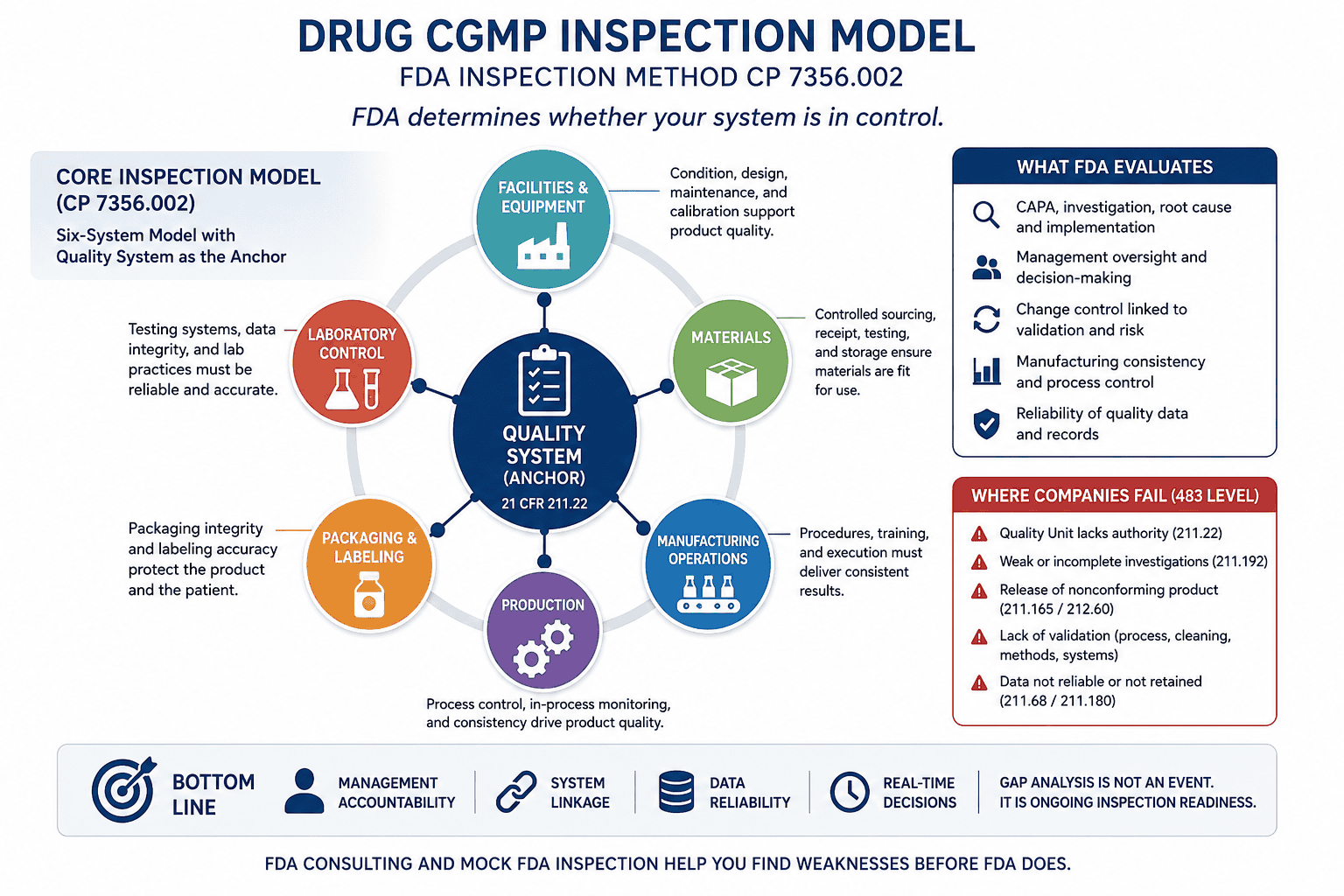
FDA’s Drug CGMP Inspection Model under CP 7356.002 evaluates whether pharmaceutical manufacturing systems remain in a state of control. The model uses six systems: Quality, Facilities and Equipment, Materials, Production, Packaging and Labeling, and Laboratory Control. FDA places the Quality System at the center of the inspection and examines how management oversees compliance. Investigators also assess CAPA, investigations, validation, process control, data reliability, and links between systems. Strong FDA consulting should prepare manufacturers for this system-based approach, not just document review. A mock FDA inspection can test whether records, decisions, and operations withstand the same type of scrutiny. Weak investigations, inadequate quality authority, validation gaps, and unreliable data can signal broader control failures. Effective readiness requires management accountability, reliable records, connected systems, and timely decisions before FDA arrives. This approach helps manufacturers expose systemic weaknesses before they become inspection findings.
Inside FDA’s Drug Inspection Framework
How the FDA Uses the Six-System Drug Inspection Model
FDA organizes drug manufacturing inspections around six systems to evaluate whether the establishment remains in a state of control. The Quality System anchors the model and remains central to inspection coverage under CP 7356.002. Investigators may also examine Facilities and Equipment, Materials, Production, Packaging and Labeling, and Laboratory Control. They select systems and products that represent the establishment’s CGMP operations and manufacturing capabilities. FDA considers an establishment out of control when any one system is out of control. Effective FDA consulting should prepare teams for system review, not isolated document checks. A mock FDA inspection can test how records, decisions, investigations, and controls connect across systems. Management must understand how weaknesses in one area can expose broader quality problems. Strong preparation focuses on system performance, reliable evidence, and consistent execution. This approach gives manufacturers a view of FDA’s inspection strategy.
The Quality System Is the Anchor of the Inspection
The Quality System anchors every drug CGMP inspection under CP 7356.002. FDA uses it to judge overall control across the establishment. Investigators examine quality oversight, procedures, approvals, investigations, change management, risk management, batch release, and management review. Senior management must support the quality unit with authority, resources, and clear accountability. FDA also looks at how quality decisions affect the other five systems. Strong FDA consulting should test those connections before inspection day. A mock FDA inspection can reveal whether quality oversight works in practice, not only on paper. Weak review, delayed decisions, or poor escalation can expose broader system failures. Management should understand that quality problems rarely stay isolated. FDA may follow evidence from one quality issue into production, laboratory, materials, or facilities. Effective readiness starts with a quality system that actively controls operations and drives timely corrective action today.
FDA Looks for a State of Control, Not Just Documentation
FDA does not stop after confirming that procedures exist. CP 7356.002 focuses on whether the establishment operates in a state of control. Investigators compare procedures with records, observations, decisions, and manufacturing performance. They look for consistent product quality across systems and over time. FDA consulting should challenge system effectiveness, not simply count documents or completed forms. A mock FDA inspection can test whether controls work when investigators follow evidence across departments. One recurring deviation may reveal weaknesses in investigations, training, validation, or management oversight. Reliable systems should detect problems, evaluate their impact, and correct causes before recurrence. FDA may expand coverage when findings suggest failures outside the original system. Management needs evidence that operations remain controlled during routine conditions and unexpected events. Inspection readiness means proving that the system performs consistently, not presenting polished procedures while practice tells another story.
Management Responsibility and Quality Unit Authority
Management responsibility sits at the center of an effective pharmaceutical quality system. CP 7356.002 expects senior management oversight and support for the quality unit. The quality unit must review and approve procedures tied to manufacturing, quality control, and quality assurance. It also needs authority to make independent quality decisions and escalate concerns. FDA consulting should examine whether that authority works in daily operations. A mock FDA inspection can test what happens when quality priorities conflict with production schedules or commercial pressure. Investigators may review how management handles deviations, change control, resources, investigations, and problems. Written responsibilities alone do not demonstrate effective oversight. Leaders need information, clear accountability, and evidence that decisions protect product quality. When management ignores warning signs, weak quality oversight can affect several systems. Strong inspection readiness requires visible leadership involvement before FDA questions who controls quality decisions.
CAPA, Investigations, and Root Cause Under FDA Scrutiny
Investigations tell FDA whether a manufacturer understands its own failures. Under 21 CFR 211.192, firms must thoroughly investigate unexplained discrepancies and batch failures. CP 7356.002 also looks for patterns of weak investigations and unresolved deviations. Root cause should follow evidence rather than convenience or assumptions. Corrective actions must address the identified cause and prevent the same problem from continuing. FDA consulting should challenge whether investigations reach far enough across related batches, systems, and operations. A mock FDA inspection can expose shallow conclusions, unsupported root causes, or ineffective follow-up. Investigators may compare deviations, complaints, laboratory results, and production records for recurring patterns. Repeated failures can show that previous corrections did not work. Management should expect questions about scope, impact, scientific justification, and effectiveness. Strong CAPA depends on disciplined investigation, clear ownership, timely action, and evidence that the system actually improved consistently.
Facilities, Equipment, and Materials Controls
Facilities, equipment, and materials create the physical foundation for controlled drug manufacturing. CP 7356.002 examines buildings, maintenance, equipment qualification, calibration, cleaning, utilities, components, containers, closures, storage, and distribution controls. Investigators may observe operations to confirm that written procedures match actual practice. They also look for contamination risks, weak cleaning controls, equipment problems, and materials released outside established specifications. FDA consulting should connect these areas rather than review them separately. A mock FDA inspection can trace one materials problem into storage, testing, production, equipment, or quality oversight. Change control also matters when equipment or material handling practices change. Water systems and computerized inventory controls may require validation depending on their intended use. Strong readiness requires clear status, traceability, approved procedures, and reliable records. These controls should consistently protect materials and manufacturing conditions before those weaknesses affect finished product quality over time.
Production, Validation, and Manufacturing Consistency
Production controls show whether a manufacturer can make the same quality product consistently. CP 7356.002 covers batch compounding, dosage form production, in-process sampling, testing, process validation, and approved manufacturing procedures. Investigators may select representative products to evaluate how production controls work across profile classes. FDA consulting should test whether procedures, batch records, equipment identification, component charge-in, sampling, and testing remain consistent. A mock FDA inspection can expose missing records, undocumented changes, weak validation, or repeated in-process failures. FDA also considers whether computerized or automated processes need appropriate validation and security. Process changes should trigger suitable evaluation, including the need for revalidation. Management must understand trends that show increasing variability or declining control. Reliable production requires disciplined execution, complete records, validated processes, and timely investigation of unexpected discrepancies. Inspection readiness means proving that manufacturing performs as intended from batch to batch.
Packaging and Labeling Controls
Packaging and labeling controls protect the correct product after manufacturing. CP 7356.002 examines label receipt, storage, issuance, reconciliation, examination, line clearance, packaging records, and operational controls. Investigators also consider controls for similar labels, printing devices, expiration dating, and packaging validation. FDA consulting should test whether these safeguards prevent mix-ups and mislabeling during routine work. A mock FDA inspection can follow one label from receipt through issuance, use, reconciliation, and finished product examination. Weak separation, poor reconciliation, or incomplete records can quickly raise concern. Change control matters when packaging equipment, labels, software, or processes change. FDA may also review computerized processes supporting packaging and labeling operations. Personnel must follow approved procedures and document what actually happened. Strong readiness depends on clear label control, effective line clearance, reliable records, and validated operations. Those controls must protect product identity through every commercial batch.
Laboratory Controls and Data Reliability
Laboratory controls provide much of the evidence used to support product quality and release decisions. CP 7356.002 covers staffing, equipment, calibration, analytical methods, reference standards, sampling, raw data, OOS investigations, and stability programs. Investigators may compare reported results with chromatograms, spectra, calculations, and other original data. FDA consulting should test whether laboratory records remain complete, traceable, and scientifically defensible. A mock FDA inspection can challenge method validation, system suitability, sampling practices, data retention, and investigation quality. FDA also examines computerized or automated laboratory processes for appropriate validation and security. Unexpected discrepancies require documented investigation, not informal explanation. Stability methods should show suitable stability-indicating capability where required. Laboratory conclusions must match the underlying raw data and approved procedures. Strong readiness requires reliable testing, controlled methods, complete records, and timely investigations. Those elements support sound quality decisions across the product lifecycle today.
Where Drug Manufacturers Commonly Lose System Control
Drug manufacturers usually lose system control through patterns, not one isolated mistake. CP 7356.002 lists recurring failures across quality, facilities, materials, production, packaging, labeling, and laboratory operations. Common problems include weak investigations, poor change control, missing records, inadequate validation, and failure to follow approved procedures. FDA consulting should look for these patterns before they spread across systems. A mock FDA inspection can connect repeated deviations, unexplained discrepancies, uncontrolled changes, or unreliable data into a broader risk picture. FDA may consider a system out of control when significant deficiencies demonstrate system failure. One system failure can support an initial OAI classification under the program. Management should therefore focus on recurring signals, not only individual observations. Strong inspection readiness depends on early escalation, effective corrective action, reliable records, and management oversight. Those controls help prevent weaknesses from becoming systemic failures over time.
Part 212 PET Drug Manufacturing Inspection Risks
PET drug manufacturing follows a different CGMP framework from standard finished pharmaceuticals under Parts 210 and 211. CP 7356.002 directs PET inspections to Compliance Program 7356.002P and 21 CFR Part 212. PET operations face unique timing, testing, and release challenges because of short radioactive half-lives. FDA consulting for PET facilities should therefore use the requirements that actually govern PET production. A mock FDA inspection can test specifications, sterility controls, endotoxin testing, aseptic practices, filter integrity, and release decisions where applicable. The uploaded summary also highlights media fills and required testing as high-risk areas. PET manufacturers need procedures and records that support rapid decisions without weakening quality controls. Management must understand when release can occur and what testing remains required. Strong readiness comes from applying Part 212 consistently. Reliable documentation, qualified personnel, and controlled production processes must support every production day.
Use a Mock FDA Inspection to Test Your Drug Quality Systems
A drug quality system should face a realistic test before FDA arrives. A mock FDA inspection can apply the six-system structure described in CP 7356.002. The exercise should cover the Quality System and select other systems based on risk, operations, and inspection history. FDA consulting adds value when it follows evidence instead of using a fixed checklist. One deviation may lead into laboratory records, production controls, materials, facilities, or management oversight. That movement shows whether systems remain connected and controlled. Teams should practice document retrieval, interviews, escalation, and technical explanations under realistic pressure. Management also needs visibility into findings that could indicate broader system failure. The goal is not to create more observations. It is to identify issues FDA is likely to pursue and correct them early. Effective preparation leaves the organization stronger, faster, and more defensible when inspection begins.
Continuous FDA Inspection Readiness Beyond a Gap Analysis
Inspection readiness should continue long after a gap assessment ends. CP 7356.002 emphasizes system control, management accountability, reliable data, and timely decisions across the drug manufacturing operation. A one-time review can identify weaknesses, but it cannot prove that corrections remain effective. FDA consulting should help management track recurring issues, verify CAPA effectiveness, monitor change control, and maintain oversight across all six systems. A mock FDA inspection adds value by testing whether improvements still work under realistic regulatory pressure. Teams should periodically challenge document retrieval, investigations, validation, laboratory controls, production records, and management escalation. New products, equipment, personnel, suppliers, or processes can introduce fresh risk. Continuous readiness keeps those changes visible before they become inspection problems. The strongest organizations treat inspection preparation as an operating discipline, not a project that begins when FDA announces an inspection or when inspection activity begins.